Freshdesk
This section will cover ClearFeed<>Freshdesk Integration
ClearFeed Freshdesk integration, is powerful and flexible, allowing agents or responders to easily setup and create bi-directionally synced tickets from Slack.
Integrate Freshdesk
Open the Settings page and head over to Integrations
Click on Connect next to Freshdesk
You will be asked to enter the Freshdesk sub-domain, as well as the API Key of your Freshdesk Account which once done, you should click on the connect button.
This will direct you to the Freshdesk sign-in page. Fill in the credentials and sign in. This step isn't required if you are already signed in to your Freshdesk account.
Once you sign in, you will be redirected to ClearFeed, and your integration will be completed.
Enable Ticketing
On the ClearFeed web application, open the Collection where you want to enable Ticketing
Click on
Settingstab, and expand theTicketing Settingssection.Enable the toggle, and choose the
Freshdeskas theTicketing Integration.Choose the Trigger Mode: Emoji (Manual) or Automatic
Emoji: Create tickets when the configured emoji is used on a message.
Automatic: Create tickets for all new messages on a channel.
Ask for Requestor Email: Enable this checkbox to associate a separate requestor email for tickets initiated by responders.
Click on
Saveto save the integration successfully

Create Tickets
Create Tickets Manually (using Emoji)

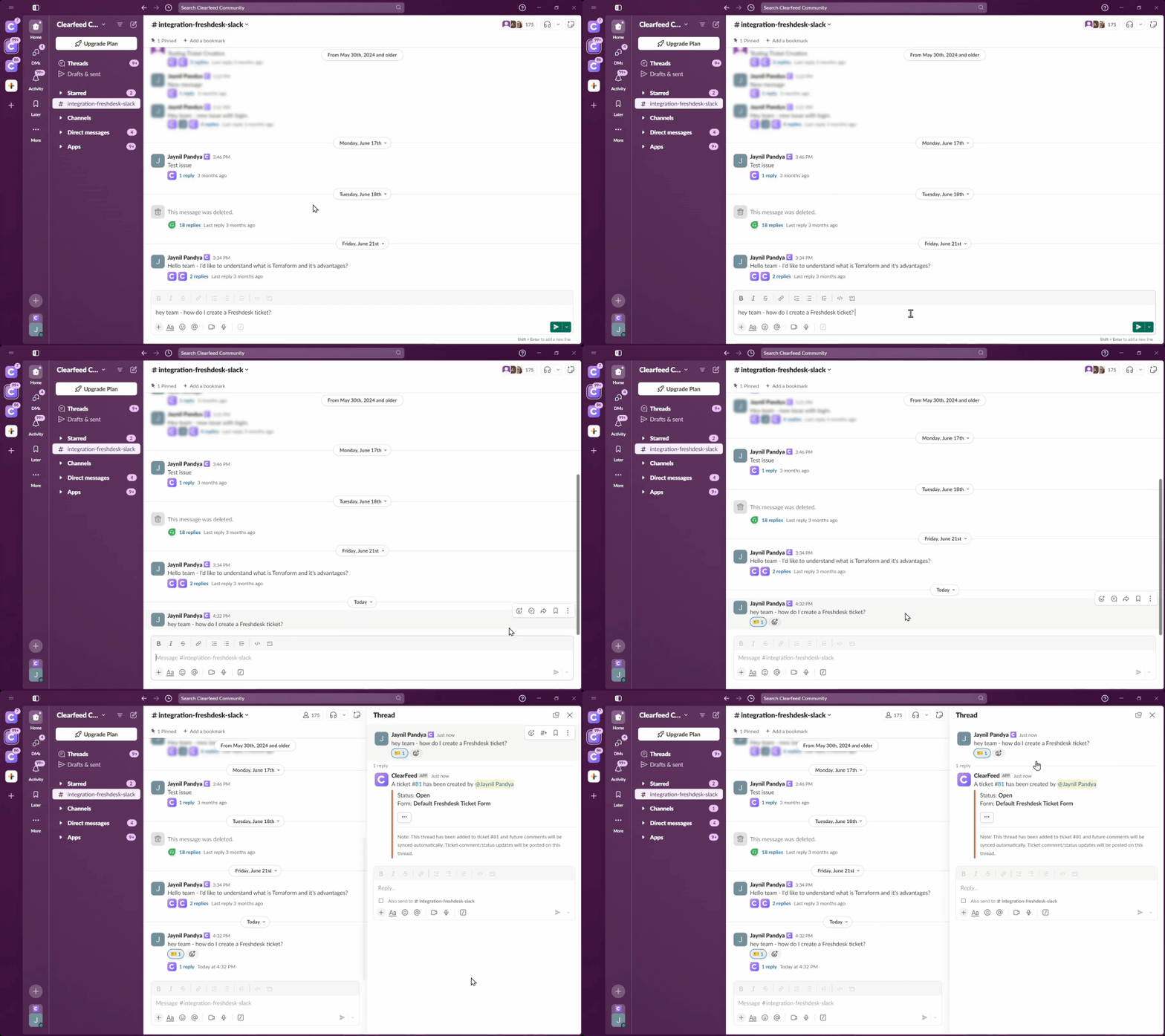
Filing Freshdesk tickets of different priorities using Emojis
You can directly file tickets of a desired priority using an emoji. This helps you and your customers raise urgent/high-priority requests in one click.
This feature isn't supported through the UI at the moment. Please reach out to us via Slack or email us at [email protected] to enable it.
Emoji Priorities - These emojis will visually signify the urgency or importance of the ticket. The following emojis are specified for different priorities:
🟦 - Low Priority
🎟️: - Medium Priority (This remains unchanged from the default setup)
🟧 - High Priority
🟥 - Urgent Priority
Create Tickets Automatically

Create from Triage Channel

Functionalities
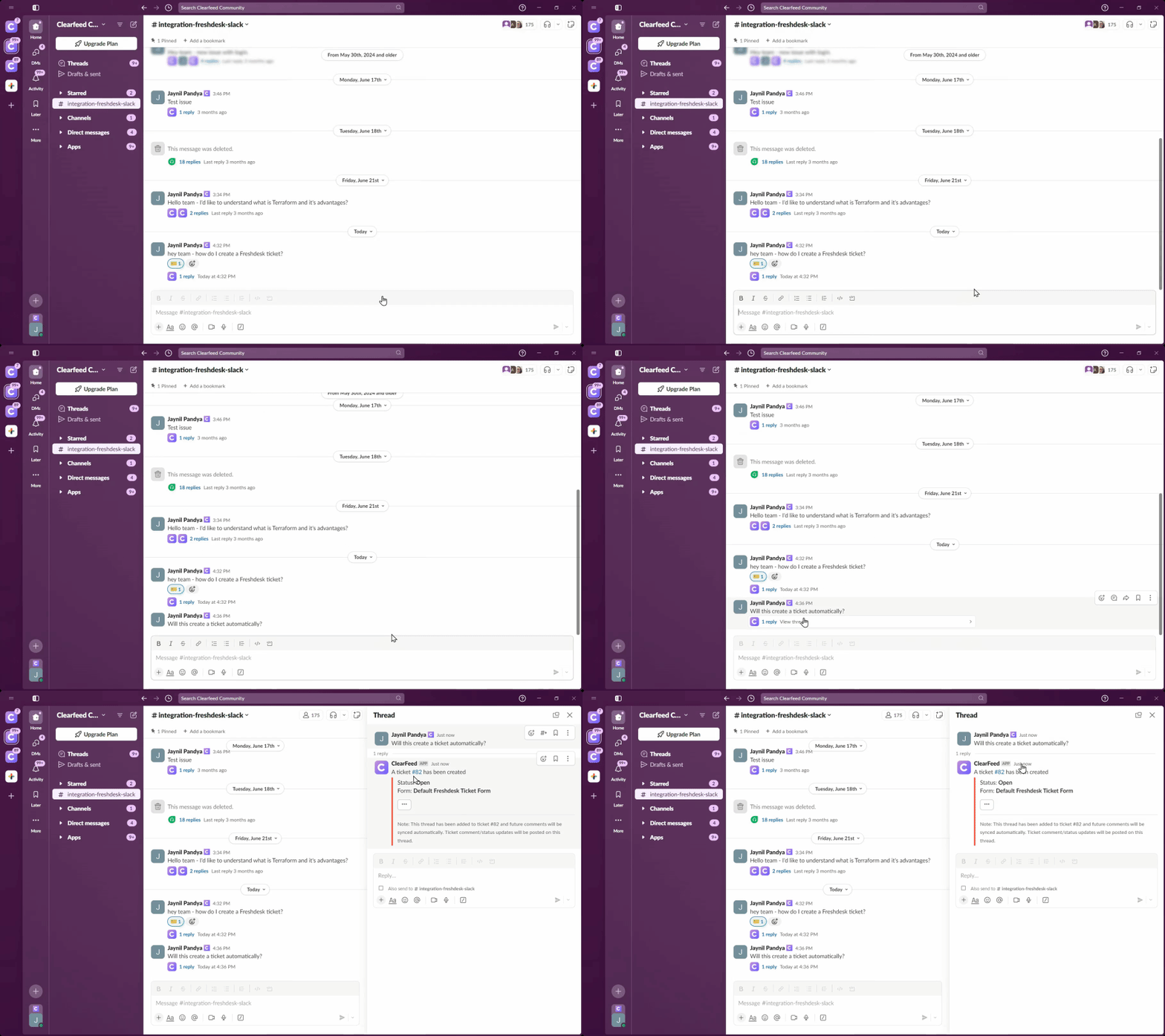
Once you create a Freshdesk ticket from Slack, ClearFeed enables the following:
Replies on the Slack thread and the Freshdesk ticket are synced bidirectionally.
The corresponding request channel thread on Slack displays the Title, ID, URL, and Status of the Freshdesk ticket.
Status changes from Freshdesk are reflected on Slack.
Freshdesk Custom Statuses are shown on Slack.
ClearFeed adds the following labels to the Freshdesk ticket: slack-channel-name, clearfeed, name of the form used to create the ticket.
Public comments from the triage channel are synced back to the Freshdesk ticket.
Internal Comments from the triage channel are synced to the Freshdesk ticket as Private Notes.
Private Notes from Freshdesk can also sync back to the triage channel.
Status change updates are posted on the Slack thread when the Freshdesk ticket is moved to Solved status.
Emoji Rules for Freshdesk
ClearFeed allows you to use emoji reactions on Slack messages to assign and resolve Freshdesk tickets directly from Slack — using both standard and custom emoji configurations.
Setting Up Emoji Rules
To enable and configure emoji rules:
Open your Collection's Settings.
Expand the Emoji Rules section.
Enable the rules you want to use.
Click the edit icon to customize the emoji for each action.
To use a custom emoji, click Add Custom Emoji and select your desired emoji.
Under Apply emoji rules for, choose one of:
External ticketing platform
ClearFeed requests & external ticketing platform
Behavior When Emoji Rules Are Applied
Once configured, emoji reactions can trigger Freshdesk ticket updates:
Reacting with 👀 (or your chosen "Assign" emoji) will:
Assign the Freshdesk ticket to the reacting user
Reacting with ✅ (or your chosen "Solved" emoji) will:
Move the Freshdesk ticket to Resolved
Who Can Trigger Emoji-Based Freshdesk Actions
Responder / Non-Responder
Can assign and resolve Freshdesk Tickets using emoji reactions, as configured.
Whitelisted Bots
Can only mark Freshdesk tickets as solved via emoji. Assign emoji will not work.
Non-whitelisted Bots
Reactions will not trigger any Freshdesk updates.
Screens
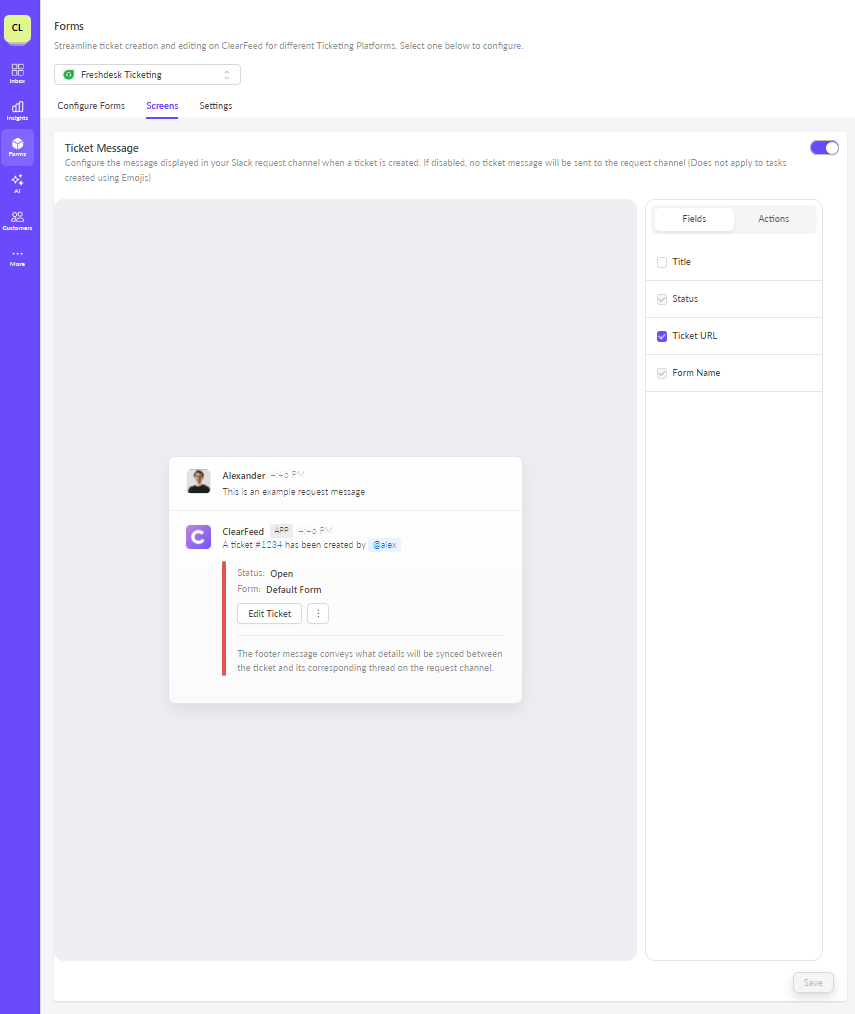
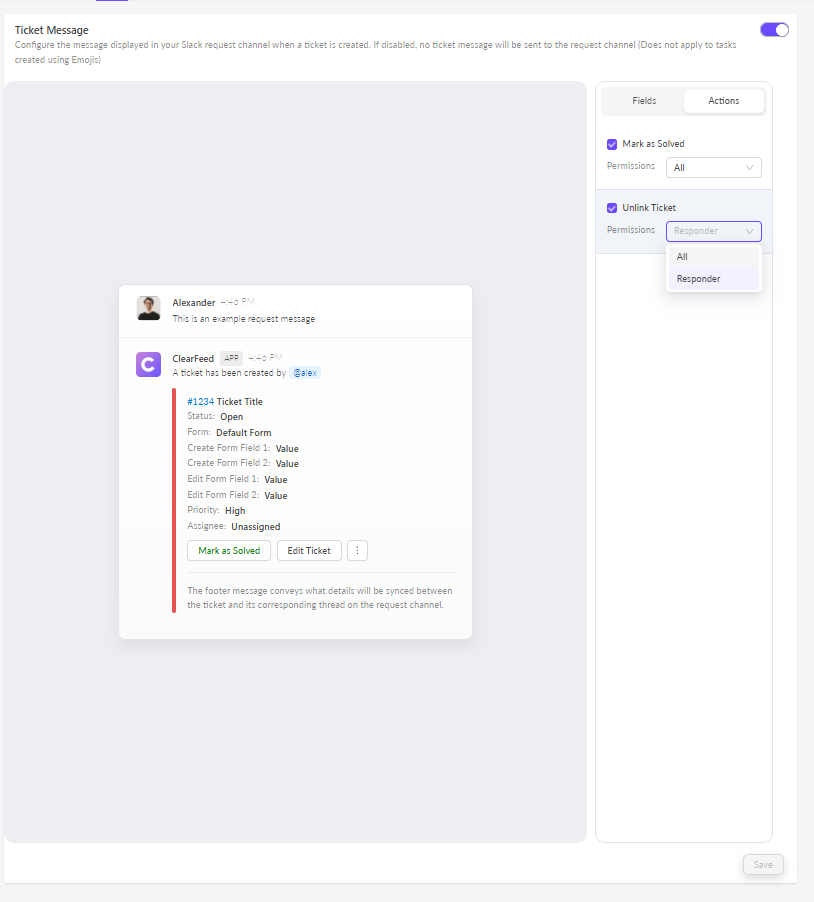
When requests are turned into Freshdesk tickets, details are sent back to the requester in a designated ticket message block on the request channel.
The screens section lets you customize the ticket message shown to the requester. You can show or hide ticket fields and manage the ticket resolution button.
To configure the ticket message for Freshdesk ticketing, follow the steps given below:
Head over to the Forms section on the ClearFeed web application
Under the ticketing drop-down, select
Freshdesk Ticketing.Select
Screensfrom the tabs mentioned under Freshdesk Ticketing.

Fields
Status - By default, the Status of the Freshdesk ticket is always shown to the requester. This cannot be configured to be hidden.
Ticket URL - Allows you to show or hide the Freshdesk ticket URL to the requestor.
Showing the URL is advisable if you have the Portal enabled for your customers.
Form Name - Name of the Form used to create the ticket.
Note: Form name appears only if there is more than one form in the account.
Title- The title of the Freshdesk Ticket can be shown to the requester using this field.

Actions
Unlink Ticket button: This button allows users to unlink a ticket from its associated request in the Request Channel. By default, it is visible only to responders in the channel. Check the option to display the Unlink Ticket button on the ticket message block.
Permissions: All or Responder.
All- Allows access to theUnlink Ticketbutton to both the requester and responderResponder- Only agents/responders will be able to use theUnlink Ticketaction to unlink tickets.\

Settings
Sync Settings
Sync settings allow you to choose whether messages are synced bidirectionally or in a single direction. Additionally, you can decide if updates to the linked ticket's status are shared in the Slack thread.
For all Tickets
To configure common sync settings for all new tickets - follow the steps below:
Access Sync Settings by navigating to Forms
Choose your Message Sync Mode
Select whether status updates are shared in the Status Sync Mode setting

For Individual Tickets
You can also configure different sync settings for individual tickets. Once a ticket is created from Slack, access the three-dot menu (shown in the illustration below) and configure your settings.
AI-Summarization Setting
You can access these settings on the Settings tab here.
If enabled, the Description of the ticket will include a summary of the thread messages followed by the messages themselves. If disabled, only the messages will be included.

Freshdesk Forms
Visit the Forms section to learn how to set up forms and utilize them for ticket creation.
FormsCreating Tickets with Forms
Once the forms are set up, users will see a File Ticket button. Clicking this button will prompt users to complete ticket creation.
If multiple forms are set up, a drop-down will appear asking the user to choose which form to fill for the particular ticket.

Edit Tickets from Slack
You can manage Freshdesk tickets filed using ClearFeed directly from a Triage channel. This allows agents to view and edit the ticket's details, and directly solve them, all from a Triage.
Reverse Freshdesk Flow
Work on Freshdesk Tickets created from other channels (eg. email, help centre, chat) from Slack using ClearFeed's Reverse Freshdesk flow.
Setup
Configuring Slack and ClearFeed to support Freshdesk ticketing
Create a dedicated Slack channel to receive the tickets and monitor the channel using ClearFeed (learn how to monitor a channel).
Configure Freshdesk as the ticketing integration for the Collection to which the channel created above is added.
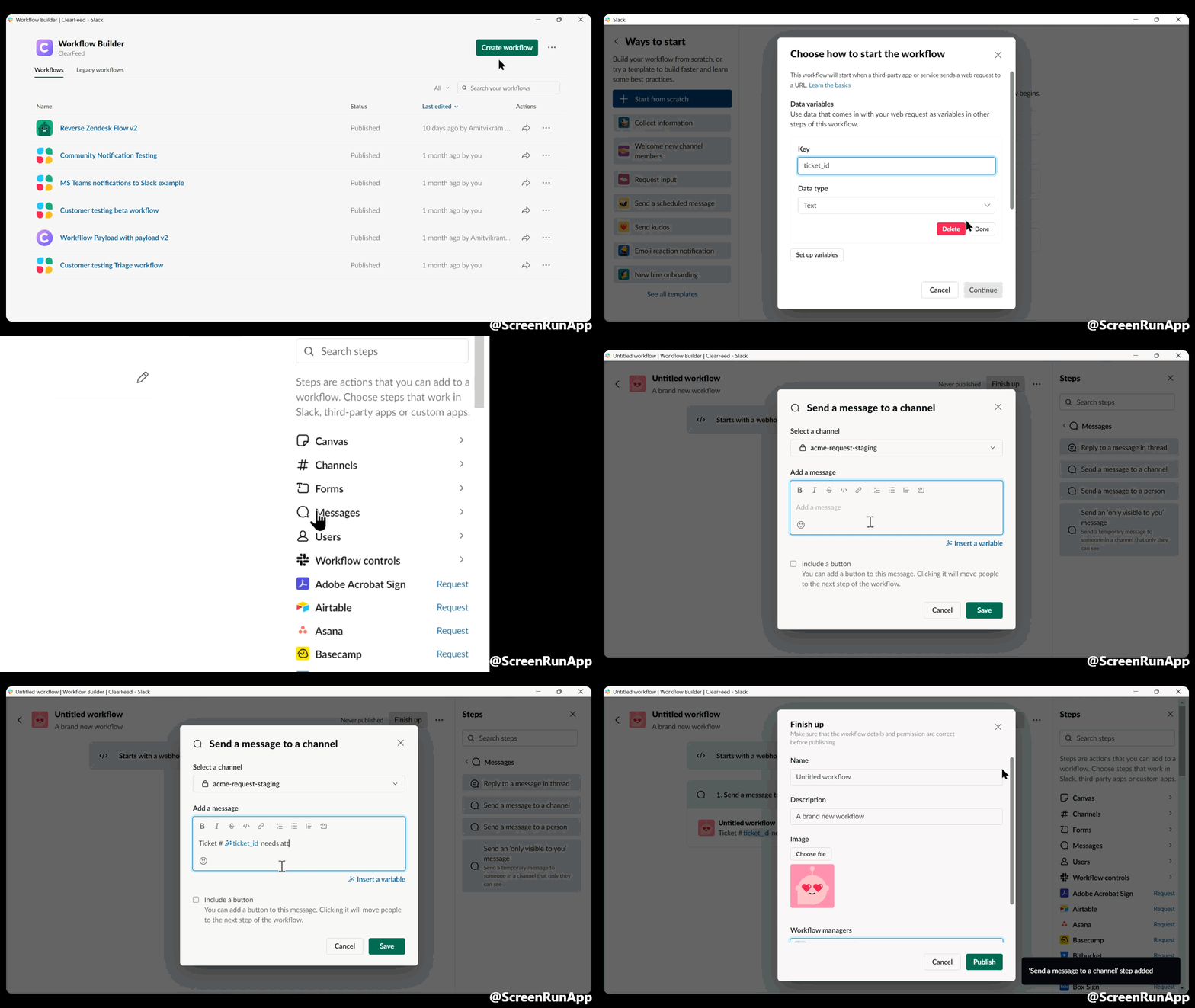
Create a new Slack Webhook Workflow
Go to Slack Workflow Builder
Create a workflow and start the workflow from a webhook
Configure the variables ticket_id
As a next step, select Send Messages to a channel
Select the channel that we configured in Step 1
Add the message exactly as follows: Ticket #ticket_id needs attention
You can add more details/variables to the message after the first line. Make sure the first line stays as shown above.
Finish and publish the workflow

Copy the Web Request URL from the webhook workflow step once published.

Whitelist the Slack Webhook Workflow Bot: Go to the following page → https://web.clearfeed.app/settings/additional-settings and under Bot Whitelisting Preferences, select and add the bot with the same name as the webhook workflow created previously.
Configuring Freshdesk to send tickets to Slack
Now go to Freshdesk Admin Center → Workflows -> Automations and add a New Rule under the Ticket Creation category.
Add the following condition mandatorily:

Under the actions dropdown, select the Trigger Webhook action. Then, add the details as shown below:
Request Type: POST
URL: Place the Web Request URL we obtained from the Slack workflow

Testing the workflow
Start a ticket directly from Freshdesk via email (to the Freshdesk support group)
Notice how the ticket comes as a notification into Slack in the monitored channel
ClearFeed replies to the notification with ticket sync details
Reply to the Slack thread and observe how the comments get synced back to Freshdesk and vice-versa.
FAQs
Can you sync private notes from Freshdesk to Slack or vice-versa? Answer: Yes, you can sync internal comments from the Slack triage channel to Freshdesk and vice-versa. To configure this, you can follow the guide here.
Are there any scenarios when we cannot unlink a ticket/task from Slack? Answer: Yes - if the corresponding ClearFeed Request/Ticket is in a Solved or Closed state - tasks cannot be unlinked.
How can I route tickets to different Freshdesk Groups based on Slack channel? Answer: ClearFeed does not currently support setting the Freshdesk 'Group' field directly via forms or by moving channels between collections. To route tickets to the correct Freshdesk Group based on the originating Slack channel, set up an automation (rule) in Freshdesk:
Go to Freshdesk Admin Center → Workflows → Automations.
Create a new rule under Ticket Creation.
Add a condition to match the channel name (e.g., using a custom field or the ticket's source information).
Set the action to assign the ticket to the desired Group.
This workaround ensures tickets from specific Slack channels are routed to the appropriate Freshdesk Group.
Last updated