> For the complete documentation index, see [llms.txt](https://docs.clearfeed.ai/clearfeed-help-center/llms.txt). Markdown versions of documentation pages are available by appending `.md` to page URLs; this page is available as [Markdown](https://docs.clearfeed.ai/clearfeed-help-center/clearfeed-helpdesk/custom-fields.md).
# Custom Fields
This section will cover details of using ClearFeed Custom Fields
Custom Fields let you add properties to requests, tickets, and customers. For requests and tickets, these properties extend standard fields such as **Status**, **Priority**, and **Assignee**. They help:
* Tag requests with custom values
* Build requester-facing forms for structured data capture before ticket creation
* Enable granular reporting, especially for single-select fields
## Field Types
ClearFeed supports the following types of custom fields:
* **Single Select**
* **Multi Select**
* **Single-Line Text**
* **Multi-Line Text**
* **Number**
* **Date**
* **Date & Time**
* **User Select**
* **Attachment**
With [multiple Slack workspaces](/clearfeed-help-center/sources/manage-request-channels/slack-workspaces.md), ClearFeed **User Select** fields always use Primary workspace users, including their options and defaults. This also applies when a customer opens a form in Secondary. Selecting a person in a field does not mention their Secondary profile.
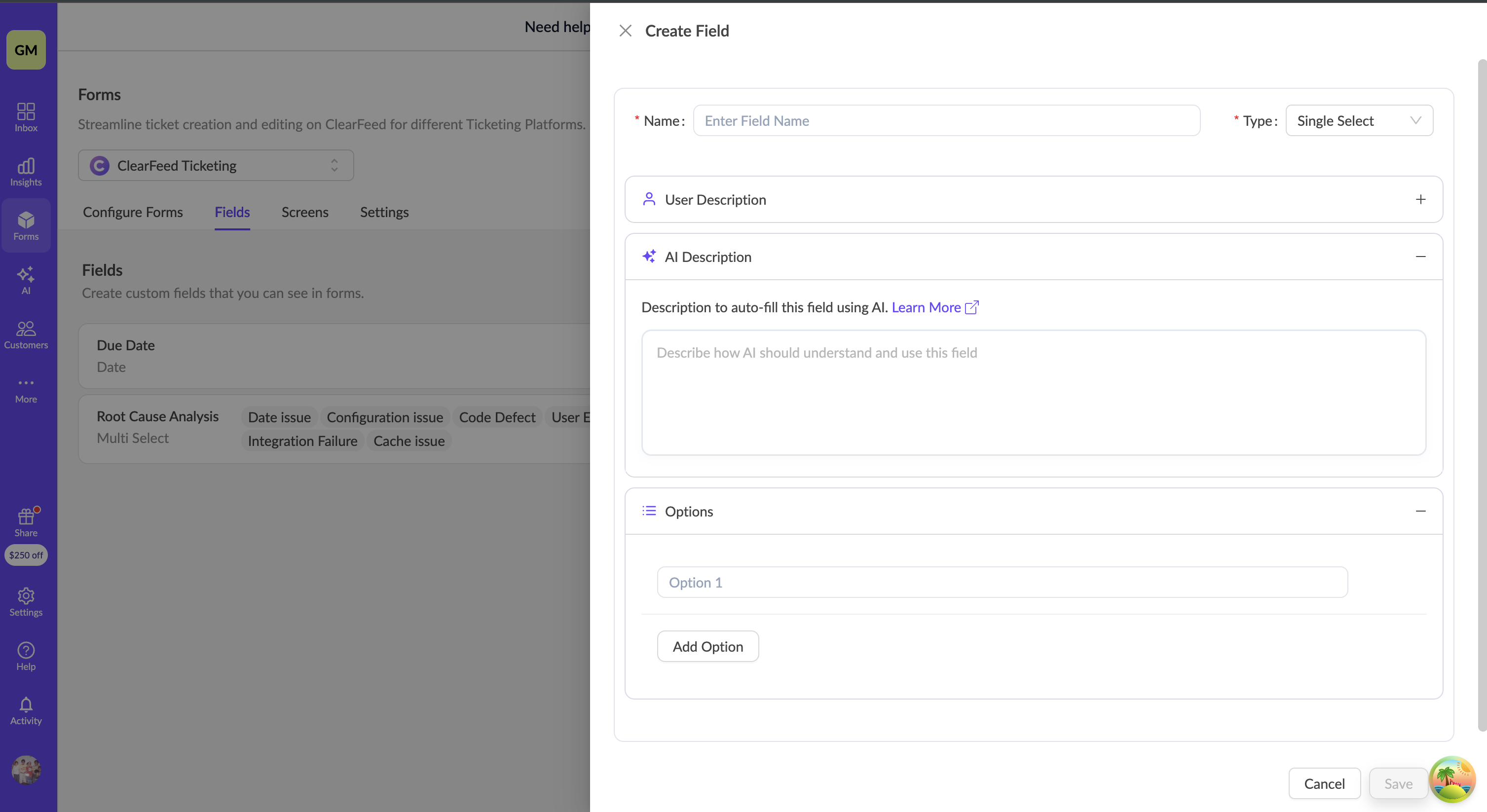
## Creating a New Custom Field
* Go to [**Forms**](https://web.clearfeed.app/objects/clearfeed) on the ClearFeed WebApp.
* Click on **Fields**
* Click **Create New Field**
* Choose the desired **Field Type**
* (Optional) For **Text** fields, specify the **Character Limit.**
* **(Optional) Add User Description** — Shown to end users when they fill out forms. Use this to explain what the field captures and guide users in providing the right input.
* **(Optional) Add** **AI Description** — Used to auto-fill this field with AI. Provide guidance on how AI should interpret and use this field. For Select fields, describe what each option means and give an example request for it. The AI Description is sent to the AI together with the instructions of the [Auto-fill Fields action](/clearfeed-help-center/clearfeed-helpdesk/automations/automation-actions.md#auto-fill-fields). Available for all field types except User Select and Attachment
{% hint style="info" %}
* Custom Fields can be automatically filled by Auto Fill fields action in Automations using predefined instructions. This reduces manual effort and improves consistency. You define the instructions once, and they are executed every time the automation is triggered.
* Auto-filled values can always be reviewed and edited manually. Learn more about how to setup Auto Fill Fields end to end [here](/clearfeed-help-center/clearfeed-helpdesk/automations/automation-actions.md#auto-fill-fields)
* For Single Select and Multi Select fields, avoid starting option values with numeric characters (e.g., '1 - Critical'). Field values should begin with a letter.
{% endhint %}
## Usage
### **Fill via Triage**
Click the **Edit** button on any triage message in Slack to view and update the values for custom fields.
### **Fill via WebApp**
Open a request → Scroll to **Forms and Custom Fields** → Enter values.
### **Use in API Payloads**
API custom-property payloads reference custom fields by stable IDs. Select and multi-select fields also have IDs for each option.
To find and copy these IDs:
1. Go to [**Forms**](https://web.clearfeed.app/objects/clearfeed) → **Fields**.
2. Turn on **Show API IDs**. Field IDs appear next to each field type. Option IDs appear inside select and multi-select option tags.
3. Click a field ID or option tag to copy its ID.
The IDs are hidden by default and appear only in the fields list, not in the field editor. Names can change, but IDs remain stable. When creating a ticket through the API, use these IDs in the `fields` object. See [Create Ticket via Form](https://docs.clearfeed.ai/api/reference/api-reference/tickets#create-ticket-via-form) for payload details and an example.
### **Use in Forms**
Custom Fields can be added to request forms to gather structured data at the time of ticket creation. Learn how to [Create Forms](/clearfeed-help-center/clearfeed-helpdesk/forms.md#create-form)
### **Use in Automations**
Custom Fields can be referenced in automation **Send Message** and **Webhook** actions using placeholders. For User Select fields, you can reference the selected user's `name`, `email`, or `id`, for example `{{ticket.Support Owner.email}}`. Learn more in [Adding Parameters in Messages](/clearfeed-help-center/clearfeed-helpdesk/automations/automation-actions.md#adding-parameters-in-messages).
## FAQs
1. **Is there a limit on number of fields we can create?**\
**Answer:** Users can create as many single-select and multi-select fields. For the text type fields, we currently support the creation of up to 50 fields. Please contact if you want to create more than 50 text-type fields.
2. **How many fields will be displayed in the triage request block?**\
**Answer:** The first five configured custom fields will be shown on the triage message block. However, all the created custom fields will be visible once you click on the `Edit` button on Triage. All the fields will also be visible on the ClearFeed Web App.
3. **Can I bulk upload values for a custom field (e.g., via CSV import)?**\
**Answer:** Currently, ClearFeed does not support bulk uploading of field values (such as options for a single-select or multi-select field) via CSV or similar methods. You can use the [Custom Fields API](https://docs.clearfeed.ai/api/reference/api-reference/custom-fields#update-custom-field) to bulk add field values programmatically. Alternatively, if you have a large number of values to add, please contact support—one-time manual insertion may be possible as a workaround in some cases.