> For the complete documentation index, see [llms.txt](https://docs.clearfeed.ai/clearfeed-help-center/llms.txt). Markdown versions of documentation pages are available by appending `.md` to page URLs; this page is available as [Markdown](https://docs.clearfeed.ai/clearfeed-help-center/clearfeed-helpdesk/assignment-rules.md).
# Assignment Rules
{% hint style="warning" %}
**Availability:** Limiting First-Responder Assignment to a Rotation and Round-Robin Assignment are available on Professional and Enterprise plans. See [Pricing](/clearfeed-help-center/pricing-and-billing/pricing.md) for plan details.
{% endhint %}
Assignment Rules allow you to automatically assign incoming requests based on your support setup and team structure. This automation helps streamline your workflow and ensures requests are directed to the right people quickly. You can configure assignments to:
* Automatically assign requests to the first eligible team member who responds.
* Limit first-responder auto-assignment to eligible members of a selected **Rotation**.
* Distribute requests among the eligible members of a **Rotation** using a round-robin method.
* For integrations with external ticketing systems like Zendesk, Salesforce, or HubSpot, assign both the ClearFeed request and the linked external ticket simultaneously to the first eligible team member who responds.
For [multiple Slack workspaces](/clearfeed-help-center/sources/manage-request-channels/slack-workspaces.md), assignees and rotation members use Primary profiles. A reply in a Secondary channel counts toward response-time SLAs but does not trigger first-responder assignment. An eligible agent replying from Primary triage can still be assigned automatically.
## **Auto-assign to First Responder (for ClearFeed Requests and Tickets)**
This rule automatically assigns the ClearFeed request to the first eligible team member who takes an action on the request within Slack, such as replying to the initial message or reacting to it. Follow the steps to enable:
* Navigate to the **Collection** where you want to enable or modify assignment rules.
* Open **Settings** for that Collection.
* Select **Assignment Rules**.
* Select the assignment rule: **Auto-assign to the first responder**.
* Optional: Select **Only assign to people from the following rotation**, then choose the Rotation that should be allowed to receive first-responder assignments.
* Click **Save**.
Setting up auto assignment to first responder
### Limit first-responder assignment to a Rotation
Use **Only assign to people from the following rotation** when first-responder assignment should apply only to a specific responder group, such as an on-call team or Slack user group.
* If no Rotation is selected, first-responder auto-assignment works as usual.
* If a Rotation is selected, ClearFeed assigns the request only when the first responder is an eligible member of that Rotation.
* For a Native Rotation, the responder can be eligible even when their shift is not live; ClearFeed does not require a live shift for this first-responder eligibility check.
* For a Slack Group Rotation, ClearFeed uses the current membership of the linked Slack user group.
* If the first responder is not eligible under the selected Rotation, ClearFeed skips auto-assignment and leaves the request unassigned.
* If your account has no Rotations, the option is disabled. Configure Rotations from **Settings → Rotations** first. See [Rotations](/clearfeed-help-center/clearfeed-helpdesk/rotations.md) for setup details.
## **Auto-assign to First Responder (for Tickets in Zendesk, Salesforce, HubSpot)**
{% hint style="warning" %}
**Note:**
* This section only applicable when **Ticketing** is enabled and has been set to **Zendesk, Salesforce** or **HubSpot** in the Collection settings.
* If the ticket is already assigned to some agent on **Zendesk/HubSpot/Salesforce** at the time of the first response on Slack, no assignment will be performed by ClearFeed.
{% endhint %}
When this rule is enabled, the first eligible team member who interacts with the request in Slack will be automatically assigned **both** the ClearFeed request and the linked Zendesk, HubSpot or Salesforce ticket. Follow the below steps to enable:
* Navigate to the **Collection** where you want to enable or modify assignment rules.
* Open **Settings** for that Collection.
* Select **Assignment Rules**.
* Select the assignment rule: **Auto-assign to the first responder for ClearFeed requests and external tickets**.
* Optional: Select **Only assign to people from the following rotation**, then choose the Rotation that should be allowed to receive first-responder assignments.
* Click **Save**.
Setting up assignment to First Responder for ClearFeed requests and external tickets
When auto-assignment occurs, ClearFeed sends a private (ephemeral) notification message in Slack to the assignee. This message is only visible to the assigned team member and is not visible to customers. you can also just dismiss and ignore the message but if you do not wish to receive these auto-assignment notifications, you can:
* Turn off the auto-assignment feature in your Collection's Assignment Rules settings (only advised if you are using an external system and ClearFeed is not being used to assign requests)
* Select 'Don't show again' to suppress future pop-ups for yourself.
For all assignment notifications, see [Assignment Notifications](/clearfeed-help-center/clearfeed-helpdesk/notifications.md#assignment-notifications).
## **Round Robin Assignment**
With Round Robin, ClearFeed picks the next assignee from the eligible members of a **Rotation**. A rotation defines who is on-call and how availability is tracked. See [Rotations](/clearfeed-help-center/clearfeed-helpdesk/rotations.md) for the full explanation, including how to create one.
Round Robin is different from limiting first-responder assignment to a Rotation: Round Robin chooses the assignee automatically from the Rotation, while first-responder assignment still depends on a team member responding in Slack and only checks that the responder is a member of the selected Rotation.
### Setting Up Round Robin Assignment
* Navigate to the **Collection** where you want to enable or modify assignment rules.
* Open **Settings** for that Collection.
* Select **Assignment Rules**.
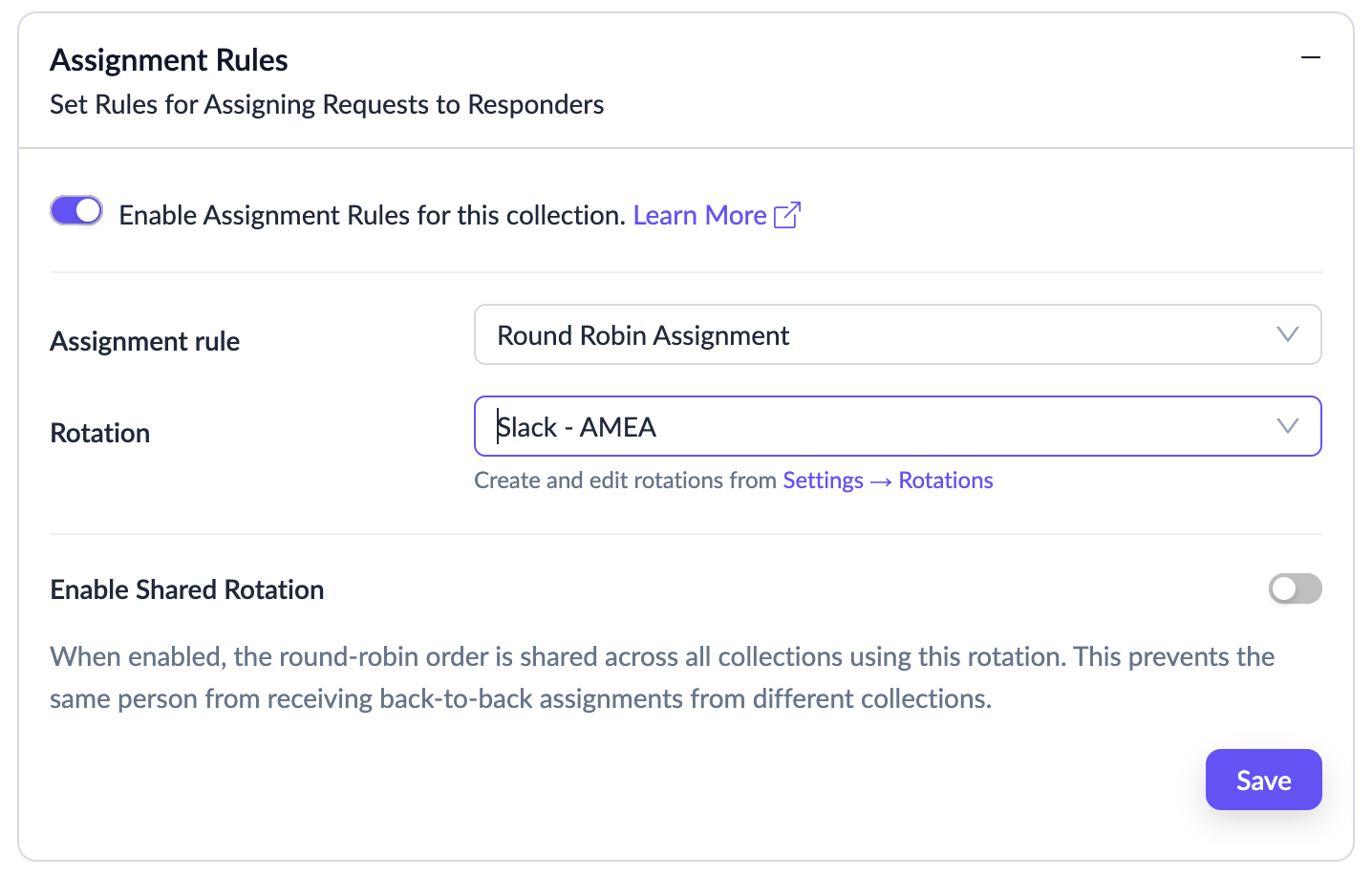
* Select the assignment rule: **Round Robin Assignment**.
* Select the desired **Rotation** from the dropdown menu.
* Optionally **Enable Shared Rotation**: When enabled, the round-robin order is shared across all collections that use this rotation. This prevents the same person from receiving back-to-back assignments from different collections.
* Click **Save**.
Setting up Round Robin Assignment
{% hint style="info" %}
**Important Notes for Round Robin:**
* **Internal Helpdesk:** In an Internal Helpdesk Collection, only users designated as agents within ClearFeed are assigned tickets via Round Robin, even if the rotation contains non-agents.
* **Self-Assignment Skip:** If an agent creates a request and is up next in the round-robin sequence, they are skipped and the request goes to the next eligible member.
{% endhint %}
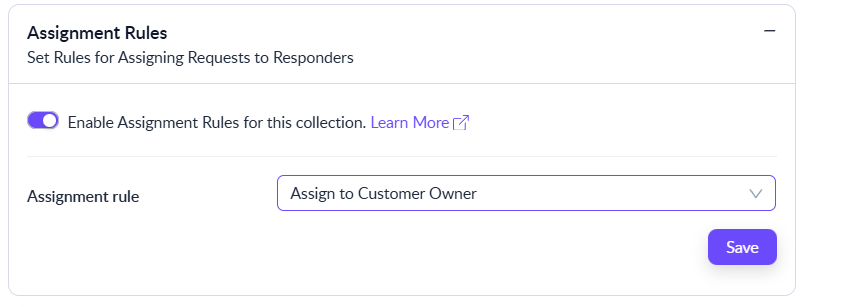
## Assign to Customer Owner
If your account is on the **External Product Edition** and uses the **Customer-Centric Inbox**, you can configure requests and tickets to be automatically assigned to the **Customer Owner**.
### How it works
* Each customer has a **Customer Owner**:
* Explicitly set on the customer, or
* Inherited from the collection the customer belongs to
* When a new request or ticket is created, ClearFeed assigns it directly to the Customer Owner
This policy ensures requests are handled by the person most familiar with the customer.
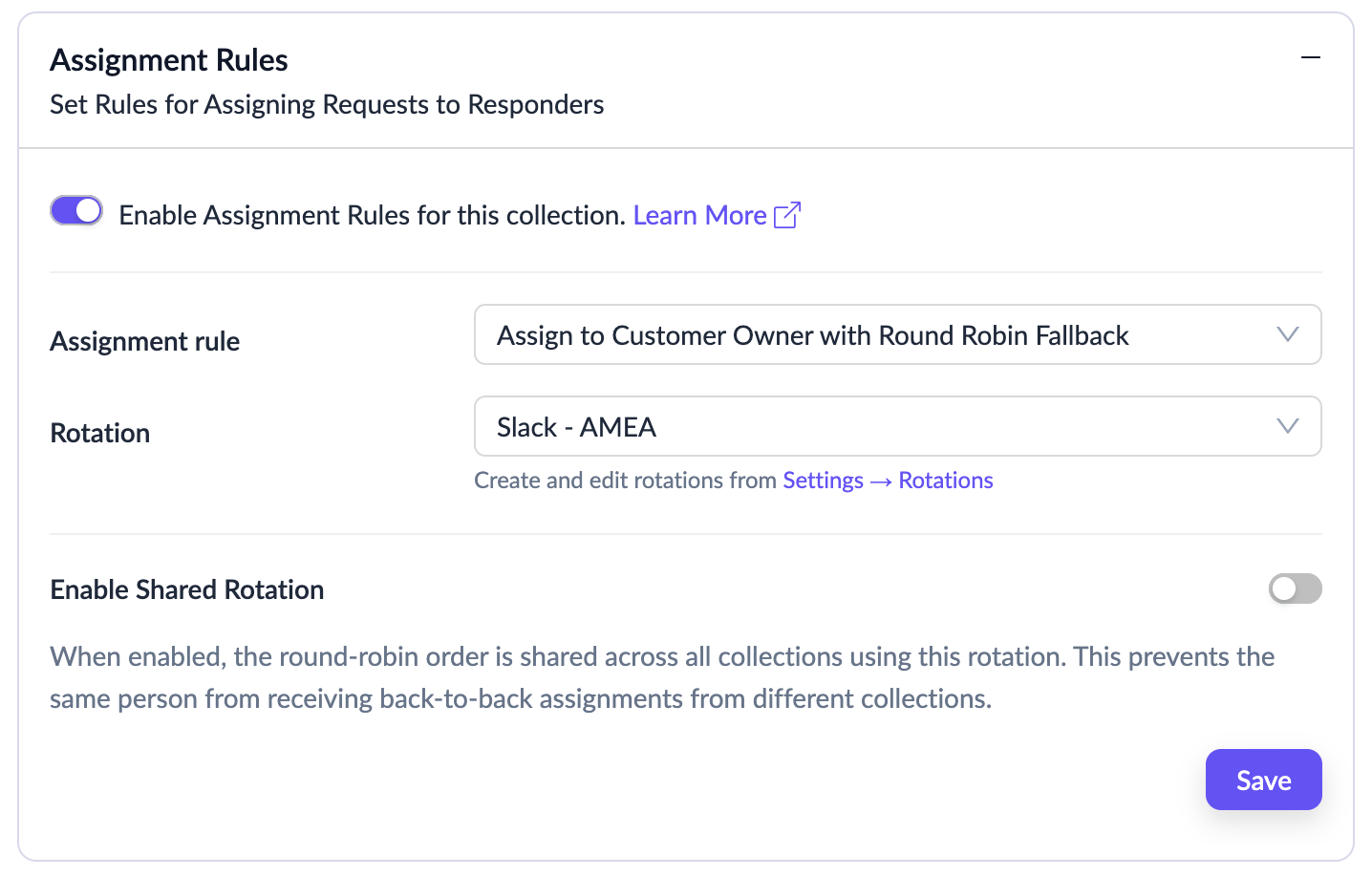
## Assign to Customer Owner with Round-Robin Fallback
This policy is available if your account is on the **External Product Edition** and configured with the **Customer-Centric Inbox**.
It extends the *Assign to Customer Owner* policy by adding an availability-aware fallback.
### How it works
1. When a new request or ticket is created, ClearFeed identifies the **Customer Owner** (explicit or inherited).
2. ClearFeed checks the owner’s availability using their **Slack status** based on the linked rotation's unavailability statuses.
3. If the Customer Owner is **available**, the request is assigned to them.
4. If the Customer Owner is **out of office**, ClearFeed picks an eligible member from the configured fallback Rotation.
This ensures requests are never blocked due to unavailability while still prioritizing customer ownership.
## Triggering Reassignment via Automations
You can use the **Reassign** automation action to reassign requests/tickets based on the collection's assignment rules. This is useful when customers re-open tickets or post new messages and the current assignee is no longer available, has been removed from the workspace, or no longer matches the configured assignment rule. See [Automation Actions > Reassign](/clearfeed-help-center/clearfeed-helpdesk/automations/automation-actions.md#reassign) for details.
## FAQs
1. **If users are marked as unavailable on Slack, how are requests assigned on Round Robin Assignment?**\
**Answer:** If a user's Slack status matches one of the rotation's unavailability statuses, they're skipped and the request goes to the next eligible member of the rotation.
2. **What if nobody in the rotation is eligible when a request comes in?**\
**Answer:** No round-robin assignment happens for that request. For a Native Rotation, this means no shift is active; for a Slack Group Rotation, it means the linked group is empty or every member is on an unavailability status. Make sure your rotation covers the hours you expect requests to be auto-assigned.
3. **What happens if the first responder is not in the selected Rotation?**\
**Answer:** ClearFeed skips first-responder auto-assignment for that request. If a subsequent responder is an eligible member of the selected Rotation (and the request is still unassigned), the assignee is set to them. If another assignment rule matches or manual assignment occurs, that takes precedence.
4. **For first-responder assignment, does the selected Rotation need to have a live shift?**\
**Answer:** No. For first-responder auto-assignment, the selected Rotation works as an eligibility allowlist. The responder must be eligible under the Rotation, but their shift does not need to be live.
See [Rotations](/clearfeed-help-center/clearfeed-helpdesk/rotations.md#faqs) for FAQs about rotations themselves (shifts, Slack groups, sharing rotations across collections, migration).
.png?alt=media)
.png?alt=media)