# Email

## Table of Contents

* [How does Email Ticketing work in ClearFeed?](#how-does-email-ticketing-work-in-clearfeed)
* [Configuring Email Ticketing](#configuring-email-integration-and-auto-response)
* [Setting up Email Forwarding](#setup-email-forwarding)
* [FAQs](#faqs)

## How does Email Ticketing work in ClearFeed? <a href="#how-does-email-ticketing-work-in-clearfeed" id="how-does-email-ticketing-work-in-clearfeed"></a>

* Admins have to configure Email addresses in ClearFeed where incoming support emails are received.
* New incoming messages to these configured Email addresses create Tickets in ClearFeed.
* Newly created Tickets are posted to the configured Triage Slack channels. Each ticket creates a thread in Triage.
* Agents can respond to these Tickets by replying in the corresponding Triage thread.
* Replies posted in the Slack Triage thread are automatically sent back to the requester via Email.
* Similarly, subsequent Email replies by the Requester are appended to the Slack Triage thread as well.
* Replies from both Agents and Requesters are appended to the same Email thread.
* Agents can also respond to Email Tickets from the ClearFeed Webapp.

Agents can perform all other collaboration and ticket management on Email tickets (like posting private comments, tagging co-workers, updating the ticket state or linking it to Tasks) from Triage channel or the ClearFeed Webapp - just like they can do with tickets and requests from Slack, WebChat or Microsoft Teams.

## Configuring Email Ticketing in ClearFeed <a href="#configuring-email-integration-and-auto-response" id="configuring-email-integration-and-auto-response"></a>

Configuring Email Ticketing requires three important Steps:

1. Configuring Email addresses where customer queries will be received.
2. Configuring Email Collections, Triage channel and other Ticketing settings for emails received on configured Email addresses.
3. (Optionally) Configure an Outgoing Email Address using which ClearFeed will send emails to requesters.
4. (Optionally) Customize the Email auto-response and signatures to tailor the Email ticketing experience.

{% hint style="success" %}
ClearFeed can support multiple incoming Email addresses from multiple custom domains and they can be routed flexibly to one or more Triage channels.
{% endhint %}

### Step 1: Configuring Incoming Email Address in ClearFeed

There are two ways to configure an incoming email address. Either use the default one provided by ClearFeed, or add your own.

#### Option 1: Use ClearFeed provided Email

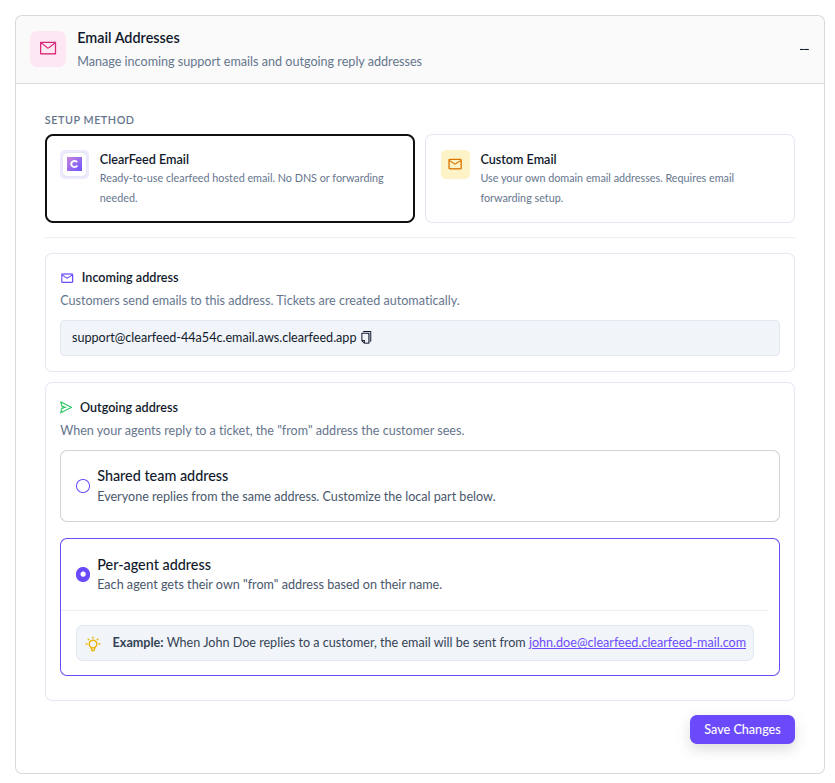
If you don't have an existing email, use a ClearFeed configured support email of the format -> **support@\<subdomain>.clearfeed-mail.com.**

{% hint style="info" %}
**Note:**

* This is **pre-configured** for all accounts on the **Internal** and **External Helpdesk** editions.
* If your account was created using a **free email domain** (like Gmail), you can generate up to **100 tickets**. Once this limit is reached, ClearFeed automatically sends **email and Slack notifications** to all account admins.
  {% endhint %}

1. Go to [Email Setup](https://web.clearfeed.app/settings/email-setup) on the ClearFeed Web Dashboard
2. Click on **Setup**
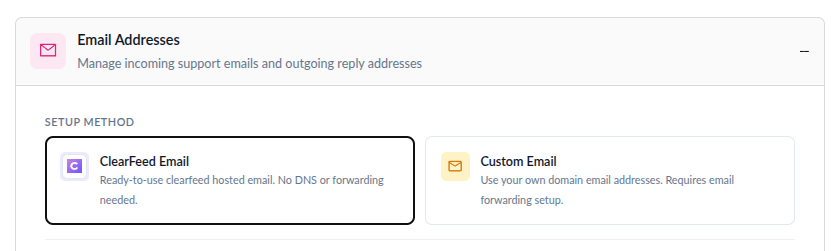
3. Under **Add Support Emails** choose **ClearFeed Email**
4. You can find the email address listed.

Once this is done, you may need to create an **Email Collection**. Read here on how to proceed. (**Note**: An Email Collection is already pre-created for new accounts with the default ClearFeed email - but you may still need to tweak it's settings.)

<figure><img src="https://3455705434-files.gitbook.io/~/files/v0/b/gitbook-x-prod.appspot.com/o/spaces%2FE2O2wTaNovd6fXpEuLKz%2Fuploads%2FgbBMcMeGuKSYsRfP7iSP%2Fimage.png?alt=media&#x26;token=50e2c48a-9bf6-4a32-a00c-1ee5abc00688" alt="" width="554"><figcaption></figcaption></figure>

#### Option 2: Using Custom Email(s)

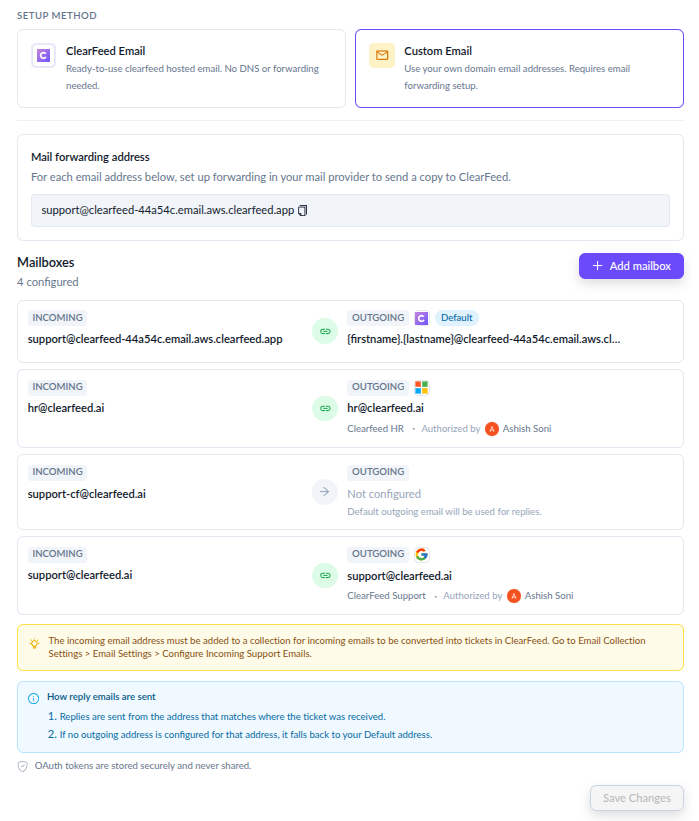
Setting up a custom Email requires first configuring the Email address in ClearFeed and then forwarding emails correctly from these custom emails to ClearFeed.

**How to configure custom Email addresses in ClearFeed**

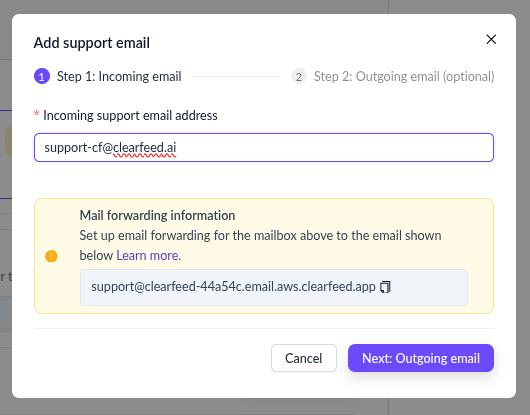
* Go to [Email Setup](https://web.clearfeed.app/settings/email-setup) on the ClearFeed Web Dashboard
* Click on **Setup**
* Under **Add Support Emails** choose **Custom Email**
* Enter your custom support email address
  * You can also add multiple custom email addresses by simply typing them out in the email address section and hitting enter.
  * Incoming emails on different custom email addresses can be routed to different triage channels for better segregation.

**How to forward emails from custom Email address to ClearFeed**

After setting the custom email addresses - we need to forward emails received on those addresses to ClearFeed. **Please read the following guides to make sure you have set your forwarding/group correctly:**

1. [**Using Mail Forwarding**](#use-mail-forwarding)
2. [**Using Google Group**](#use-a-google-group)
3. [**Using Microsoft 365 / Outlook**](#use-microsoft-365-outlook)<br>

   <figure><img src="https://3455705434-files.gitbook.io/~/files/v0/b/gitbook-x-prod.appspot.com/o/spaces%2FE2O2wTaNovd6fXpEuLKz%2Fuploads%2FmANUTPNni3UjOb89OdNn%2Fimage.png?alt=media&#x26;token=25c7bb06-791d-4e05-98c3-2153fb10648e" alt="" width="563"><figcaption></figcaption></figure>

### Step 2: Creating & Configuring Email Collection <a href="#creating-an-email-collection" id="creating-an-email-collection"></a>

An Email Collection is simply a dedicated [Collection](https://docs.clearfeed.ai/clearfeed-help-center/product-features/collections) used to store email tickets.

{% hint style="success" %}
Note that an Email Collection with the default ClearFeed Email Address should be pre-configured in your account. The steps here are useful for creating and configuring additional collections for custom Email addresses.
{% endhint %}

To create a new Email Collection, perform the following steps:

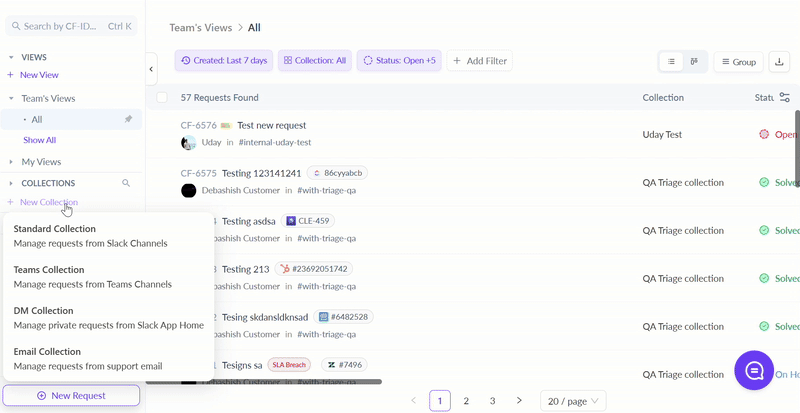
1. Go to **Collections** -> click on **Add New Collection** -> Select **Email Collection**.
2. Add Responders (these will be users responding to these tickets).
3. **(Optional/Strongly Recommended) Associate a triage channel**: You can also create or link an existing triage channel to the Email Collection.
   * Learn more about Triage channels [here](https://docs.clearfeed.ai/clearfeed-help-center/clearfeed-helpdesk/interfaces/triage-channel).

Once an Email Collection exists - one must attach the incoming Support Email associated with that Collection. This must be done via Collection Settings:

1. Click on the Email Collection from the Inbox section of the ClearFeed Webapp
2. Open the Collection Settings accessible by clicking **Settings** from the Top Right
3. Go to the section named **Email Settings:** Expand the Choose the support email(s) that send incoming emails to this Collection.

If there are multiple incoming email addresses - you can configure multiple email collections - one for each of them. The emails can be routed to different (or same) triage channels.

<figure><img src="https://3455705434-files.gitbook.io/~/files/v0/b/gitbook-x-prod.appspot.com/o/spaces%2FE2O2wTaNovd6fXpEuLKz%2Fuploads%2FKZ7MB5p4d95nFlJSW8F2%2Fimage.png?alt=media&#x26;token=cce6e362-c81b-46d5-a8b2-8a4d19d02bf9" alt="" width="563"><figcaption></figcaption></figure>

### Step 3 (Optional): Customize Outgoing Email Address

Configure the email address used to send outgoing emails from Slack to your customers. Choose from one of the three different formats supported by ClearFeed:

#### Option 1: Standard ClearFeed Email

Use the ClearFeed-provided email address to send outgoing messages to your customers.

You can customize the prefix (e.g., support, help, info) as well as the Name for the outgoing email address.

**Example**

**Email Address :** `support@acme.clearfeed-mail.com`

**Name:** ClearFeed Support

<figure><img src="https://3455705434-files.gitbook.io/~/files/v0/b/gitbook-x-prod.appspot.com/o/spaces%2FE2O2wTaNovd6fXpEuLKz%2Fuploads%2F3gWTILovXmvJCunlb6eP%2Fimage.png?alt=media&#x26;token=6ce1558b-4ce0-44d3-a6ad-0a290d11860a" alt="" width="554"><figcaption></figcaption></figure>

#### Option 2: Personalized ClearFeed Email

Automatically generates an email based on the responder's name.

**Format:** `{{firstname}}.{{lastname}}@<your company name>.clearfeed-mail.com`

**Example:** When John Doe replies to a customer, the email will be sent from `john.doe@acme.clearfeed-mail.com`

<figure><img src="https://3455705434-files.gitbook.io/~/files/v0/b/gitbook-x-prod.appspot.com/o/spaces%2FE2O2wTaNovd6fXpEuLKz%2Fuploads%2FAkL7wvaduntymzblW1xy%2Fimage.png?alt=media&#x26;token=49fbe005-12c7-4ca6-834d-e91a949727fe" alt="" width="546"><figcaption></figcaption></figure>

#### Option 3: Custom Email Address

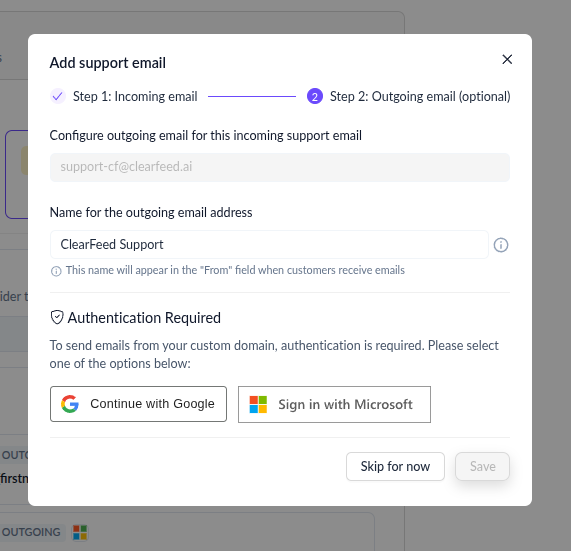
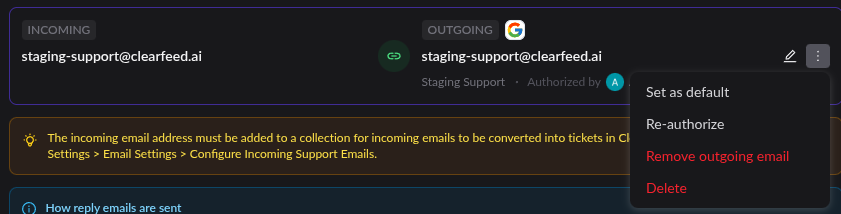
Use your own domain email address for outgoing emails. This is only available if you have configured a Custom Email Address and Email Service Provider is Google or Microsoft.<br>

<figure><img src="https://3455705434-files.gitbook.io/~/files/v0/b/gitbook-x-prod.appspot.com/o/spaces%2FE2O2wTaNovd6fXpEuLKz%2Fuploads%2FhUVWvnuZeoLU7ce7uhb2%2Fimage.png?alt=media&#x26;token=7b5c0a95-8233-4f7a-a0ae-b41bd6a64819" alt="" width="541"><figcaption></figcaption></figure>

#### Setup Steps:

1. **Select a custom email address** from the support emails you configured in Step 1
2. **Enter a display name** for the outgoing address (e.g., "Support Team", "Customer Service")
   * This name will appear in the "From" field when customers receive emails
3. **Authenticate with Google or Microsoft** to allow ClearFeed to send emails on your behalf

{% hint style="danger" %}
**Important Information: Using Google Groups or Shared Mailboxes**

If you are using a **Google Group email address** (e.g., `support@company.com`) or an **email alias** that is not your primary Google account:

**You MUST configure "Send mail as" in Gmail before authenticating**, otherwise emails will be sent from your personal email address instead of the intended group/alias email.

**Required Steps:**

1. **Before clicking "Continue with Google"**, add the Google Group/alias as a "Send mail as" address in your Gmail settings:
   * Go to Gmail Settings → Accounts and Import → Send mail as
   * Click "Add another email address"
   * Enter the Google Group/alias email (e.g., `support@company.com`)
   * Follow the verification steps
2. **Verify you have permission** to send emails as the Google Group (check with your Google Workspace admin if unsure)
3. **Complete authentication** in ClearFeed using the Google account that has the "Send mail as" configured
4. **Send a test email** to verify the setup is working correctly

**Detailed Instructions:** [How to set up "Send mail as" in Gmail](https://support.google.com/mail/answer/22370)

**If you authenticate without configuring "Send mail as", ClearFeed will send emails using your personal email** address (e.g., `john@company.com`) instead of the intended group email (e.g., `support@company.com`).

**This means:**

* Customers will see replies from your personal email
* Reply-to addresses may not work as expected

**Gmail does not notify us if the wrong email is used**, so it's critical to verify your setup by sending a test email.
{% endhint %}

{% hint style="danger" %}
**For Microsoft 365 Users**

If you are using a **shared mailbox** or **email alias, you MUST have `SendAs` permissions granted by your Exchange administrator**, otherwise emails will be sent from your personal account or fail to send.

**Required Steps:**

1. **Before clicking "Continue with Microsoft"**, contact your Exchange administrator to:
   * Grant `SendAs` permissions to your user account for the shared mailbox/alias
   * Verify the permissions are properly configured
2. **Complete authentication** in ClearFeed using your Microsoft account
3. **Send a test email** to verify the setup is working correctly

**Detailed Instructions:** [Microsoft documentation on SendAs permissions](https://learn.microsoft.com/en-us/exchange/recipients-in-exchange-online/manage-permissions-for-recipients)

**Note about display names:**

The custom display name you enter may be replaced with the name of your Microsoft account by default. To use a custom display name, your Exchange administrator must configure this along with the `SendAs` permissions.
{% endhint %}

#### Verify Your Email Setup

After completing authentication, **we strongly recommend sending a test email** to ensure your configuration is correct.

#### How to Test:

1. After completing the authentication and saving Email setup, create a test ticket by sending an email to the support address you added in Step 1.
2. Now, go to ClearFeed WebApp or Slack triage channel and send a reply.
3. Check your inbox for the email
4. Verify the "From" address matches your intended outgoing email (e.g., `support@company.com`, not `john@company.com`)
5. If the test fails or shows the wrong email address, review the setup instructions above

### Step 4 (Optional): Customize Email Ticketing Behavior

Once the basic Email Ticketing setup has been done, it can be customized as per your needs. Here are some options that can help in this regard:

1. Setup an Auto-response message
2. Customize Status Updates
3. Email Thread Management

<figure><img src="https://3455705434-files.gitbook.io/~/files/v0/b/gitbook-x-prod.appspot.com/o/spaces%2FE2O2wTaNovd6fXpEuLKz%2Fuploads%2FLP176sVEkB2tyGGnF1US%2Fimage.png?alt=media&#x26;token=04acd75a-8b74-4fa6-8aad-7c90ccf8272f" alt="" width="542"><figcaption></figcaption></figure>

#### Auto-response Message <a href="#configure-auto-response-message" id="configure-auto-response-message"></a>

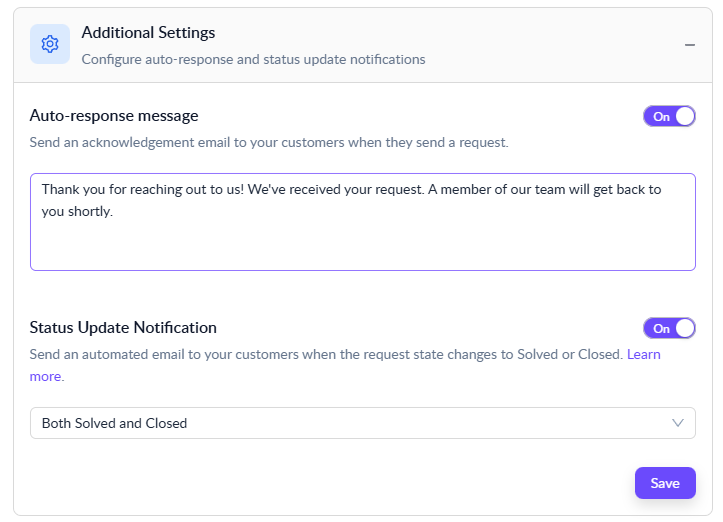
ClearFeed can automatically send an acknowledgement to requesters once they send an email for support.

* You can choose to enable/disable this acknowledgement message.
* You can also customize the message.

#### Customize Status Updates <a href="#customize-status-updates" id="customize-status-updates"></a>

ClearFeed can send **Status Update Notifications** to requestors, informing them when their email ticket has been marked as Solved and Closed. These updates are sent as automated emails on the same email thread. You can enable or disable these notifications completely from the [Email Setup](https://web.clearfeed.app/settings/email-setup) section in Settings.

**Configure the notifications to send updates only when:**

* A ticket is Solved
  * Behavior note: A ticket in Solved status will reopen automatically if the customer replies to the same email thread (even after several days), unless you have explicitly configured automations that change this behavior. ClearFeed does not automatically move tickets from Solved to Closed on its own.
* A ticket is Closed
  * Behavior note: Closed is a terminal state. Replies to a Closed ticket will not reopen the same ticket. If you want to continue the conversation, you must create a new ticket (for example, by starting a new email thread).

<details>

<summary>Example: Emails Sent on Status Updates</summary>

1. **When the ticket is moved to Solved**

Hello John, This is an automated message to inform you that we've marked your ticket CF-123 as solved. If you're satisfied with the resolution, no further action is needed. However, if you need further assistance or have additional questions, please reply to this email. Your reply will reopen the ticket, and our support team will get back to you as soon as possible. Thank you for your patience and understanding.

2. **When the ticket is moved to Closed**

Hello John, This is an automated message to inform you that we've closed your ticket CF-321. Please note: New replies to this thread will not reopen the ticket. If your issue remains unresolved or you need further assistance, kindly start a new email thread to <support@acme.com> to create a fresh ticket. Thank you for your understanding.

</details>

#### Email Thread Management <a href="#customize-status-updates" id="customize-status-updates"></a>

Control how ClearFeed manages and updates CC recipients on email-based tickets when you reply.

* **Update CCs from replies:** ClearFeed automatically adds or removes CC recipients based on the email addresses included in each customer reply.
  * If a customer removes someone from CC, that recipient will no longer receive future emails in the thread.
  * If a customer adds someone to CC, that recipient will be added to the thread and included in future replies.
* **Always Preserve Customer CCs:** ClearFeed preserves all CC recipients that customers add at any point in the conversation, even if the customer removes them in later replies.
  * Removed CCs will continue to receive future emails.
  * Agents can manually add or remove CC recipients from Slack at any time.

## Setup Email Forwarding <a href="#setup-email-forwarding" id="setup-email-forwarding"></a>

There are three ways of setting up Email forwarding from your custom email to ClearFeed:

### Method 1: Use Mail Forwarding <a href="#use-mail-forwarding" id="use-mail-forwarding"></a>

1. Enter your support Email address.
2. Setup forwarding to the domain mentioned in the **Mail forwarding information** section
   * Guide to setup forwarding: [**https://support.google.com/a/answer/10486484?hl=en**](https://support.google.com/a/answer/10486484?hl=en)
3. If you've added multiple support emails, configure the forwarding for each of the mailboxes.

### Method 2: Use a Google Group <a href="#use-a-google-group" id="use-a-google-group"></a>

1. Keep the Google Group address the same as your support email. E.g. if the support email is <support@clearfeed.ai> -> this email should also be set up as the Google Group Address.
2. Copy the ClearFeed Support email (found under Mail forwarding information in the setup) and add it to the Google Group
3. Ensure the following permissions are set up correctly:
   1. **Who can post:** Anyone on the web
   2. **Who can join group:** Invited users only
   3. **Allow External members:** ON

### Method 3: Use Recipient Address Mapping (Google Workspace) <a href="#use-microsoft-365-outlook" id="use-microsoft-365-outlook"></a>

Many organizations disable **user-level mailbox forwarding** to prevent company emails from being forwarded to personal or unapproved external accounts. This is a common security control enforced by IT teams to protect sensitive data.

#### How redirect/forward behaves

* Redirected messages appear to come **directly from the original sender**
* The **To:** field retains the original recipient address
* You can choose to:
  * Send emails **only to ClearFeed**, or
  * Send to ClearFeed **and** keep a copy in the original mailbox

#### Steps to configure in Google Admin Console

1. Open **Google Admin Console**
2. Navigate to\
   **Menu → Apps → Google Workspace → Gmail → Routing.**
3. Select **Routing** (not *Default routing*).
4. On the left, select the **top-level organizational unit**
5. Scroll to **Email forwarding using recipient address map** and click\
   **Configure** or **Add Another Rule**
6. In the **Add setting** box, enter a descriptive name\
   \&#xNAN;*Example: “Route support aliases to ClearFeed”*
7. In **Step 1 – Add address mapping**
   * **Address:** original email (e.g., <help@yourcompany.com>)
   * **Map to address:** ClearFeed inbox\
     (e.g., <tickets@yourcompany.clearfeed.io>)
8. Click **Add**
   * Repeat to map additional addresses if required
   * Bulk mapping can be used for large lists
9. Under **Messages to affect**, choose:
   * **All incoming messages** – includes internal + external emails
   * **Only external incoming messages** – customer emails only
10. Optional settings (recommended)
    * **Also route to original destination**
      * Keeps a copy in the existing mailbox during rollout
    * **Add X-Gm-Original-To header**
      * Preserves recipient info for troubleshooting and advanced routing
11. Click **Save**
12. Your rule will appear as a new row on the **Routing** page.

You can refer to [this](https://support.google.com/a/answer/4524505?hl=en#address-map-forwarding) page to learn more.

### Method 4: Use Microsoft 365 / Outlook: <a href="#use-microsoft-365-outlook" id="use-microsoft-365-outlook"></a>

{% hint style="warning" %}
**Important:** Do not use Outlook client-side rules for forwarding. Client-side forwarding does not preserve the original sender information and always creates tickets on behalf of the email address that has set up the forwarding. Instead, use server-side forwarding as described below.
{% endhint %}

To preserve the original sender information and ensure proper email threading, set up **server-side forwarding** in Microsoft 365. Choose one of the following methods:

**Option A: Microsoft 365 Admin Center (Recommended)**

Requires admin access.

1. Go to [Microsoft 365 Admin Center](https://admin.microsoft.com) → **Users** → **Active Users**
2. Select the mailbox (e.g., <support@yourcompany.com>)
3. Click the **Mail** tab
4. Under **Email Forwarding**, click **Manage forwarding**
5. Enable **Forward all emails**
6. Enter the ClearFeed forwarding address (found in your Email Setup)
7. Optionally check **Keep a copy of forwarded email in this mailbox**

**Option B: Exchange Admin Center (For complex routing)**

If you need conditional forwarding or multiple recipients:

1. Go to [Exchange Admin Center](https://admin.exchange.microsoft.com)
2. Navigate to **Mail flow** → **Rules**
3. Create a new rule:
   * **Apply this rule if:** Recipient is \<your support mailbox>
   * **Do the following:** **Redirect** the message to \<ClearFeed forwarding address>
4. **Important:** Use **Redirect** (not Forward) to preserve original sender information

**Option C: Outlook Web Redirect Rule**

1. Go to [Outlook Web](https://outlook.office.com)
2. Click **Settings** → **Mail** → **Rules**
3. Add a new rule:
   * **Condition:** Apply to all messages
   * **Action:** **Redirect to** \<ClearFeed forwarding address>
4. **Important:** Choose **Redirect**, not **Forward**

**Additional Resources:**

* [Use rules to automatically forward messages (Microsoft Support)](https://support.microsoft.com/en-us/office/use-rules-to-automatically-forward-messages-45aa9664-4911-4f96-9663-ece42816d746)
* [Configure email forwarding in Microsoft 365 (Microsoft Learn)](https://learn.microsoft.com/en-us/microsoft-365/admin/email/configure-email-forwarding?view=o365-worldwide)

## FAQs <a href="#faqs" id="faqs"></a>

1. **Is the Email integration available for all plans and product editions in ClearFeed?**\
   **Answer:** The Email integration feature is available in Internal and External Helpdesk product editions. It is available in all plans including during Trial phase.
2. **Is the email integration available on ClearFeed Child Accounts?**\
   **Answer:** Yes, Email integration is supported in both Parent and Child accounts.Note that the default ClearFeed email setup in each ClearFeed account is unique to that account and will differ in Child and Parent accounts.
3. **I am not able to create a new Email Collections or perform Email Setup in my account. What could be the reason?**\
   **Answer:** Email Integration may not be available if you have picked the Integration edition during account setup (by identifying ticketing integration with an existing tool as your primary use case).
4. **Does ClearFeed support integration with multiple custom Email addresses (potentially from different custom domains)**\
   **Answer:** Yes. You can configure multiple custom Email addresses and domains in ClearFeed as described in Steps 1 and 2 of Email Ticketing Configuration
5. **Can I use the ClearFeed provided email and a custom email both?**\
   **Answer:** Yes. You can configure one Collection with the ClearFeed provided default email id - and others with custom email ids.
6. **How can we route tickets from different custom Email addresses to separate Triage channels? Can I use the same support email in multiple collections?**\
   **Answer:** You can route incoming tickets from different custom email addresses to separate triage channels by creating multiple Email Collections one for each custom email address.
   * For each custom Email, create a new Email Collection.
   * Under `Email Settings` for each Collection, choose the support Email for this Collection (you can add multiple emails).
   * Configure a different Triage channel for each Collection.
   * The same support email address cannot be assigned to more than one collection. Each collection must have a unique support email address. - If you want the same email to reach multiple collections/triage channels, set up email aliases or separate forwarding addresses for each collection, and configure each as a unique support email in ClearFeed.
7. **Can I use a Google Group address as the outgoing email address in ClearFeed?**\
   **Answer:** Yes, you can use a Google Group address as the outgoing email address in ClearFeed. However, you must first add the Google Group address as an outgoing address in your personal Google account settings. After authenticating with your Google account in ClearFeed, ensure that you select the Google Group address from the dropdown menu and click "Save" to apply the changes.
8. **What should I do if my emails are sent from my personal address instead of the Google Group address?**\
   **Answer:** If emails are being sent from your personal address rather than the Google Group address, please check the following: 1. Ensure that you have added the Google Group address as an outgoing address in your personal Google account settings. 2. Confirm that you selected the Google Group address from the dropdown menu in ClearFeed and clicked "Save." 3. If you have authenticated correctly and still face issues, try re-authenticating your account by clicking "Continue with Google." Use this link for reference: <https://support.google.com/mail/answer/22370?hl=en>
9. **Why did replying to a ticket in Slack both send an email to the requester and create a new request in the Slack channel?**\
   **Answer**: This usually happens if multiple support email addresses are copied in the message. For example, if both the ClearFeed-generated email (e.g., `helpdesk.clearfeed-email.com`) and your forwarding address (e.g., `support@helpdesk.com`) are copied, ClearFeed may treat the reply as a new request. To resilve this, avoid copying both addresses in replies.
10. **Can I use my own support email (e.g., `support@mydomain.com`) as the sender instead of the ClearFeed-generated address?**\
    **Answer:** Yes. ClearFeed allows you to configure a **custom outgoing email address**. You can refer here for detailed steps.
11. **Do I still need to use the ClearFeed-generated email address after setting up a custom email**\
    **Answer:** No. Once your custom email is configured and authenticated, you can use it directly. There is no need to CC or reference the ClearFeed-generated email address.